You've done the hard part.
We help your systems evolve with you.
Load-bearing, by design.
Getting the business this far took real work: hard decisions, long hours, and knowing your operation better than anyone. As the business grows, the systems around it need to grow too. We partner with you to design clearer workflows, better visibility, and practical technology that supports the next stage.
The next stage of growth cannot run on yesterday's workarounds.
Every growing business reaches the point where hidden friction becomes visible. Admin starts multiplying, reports arrive too late, customers wait longer than they should, and strong teams lose momentum because the systems around them have not evolved with the business.
It Worked at First. Now It Slows You Down.
Something was created quickly to meet a real deadline, maybe by your team, a previous partner, or with AI assistance. It helped at the time. Now the business has moved on, and the system needs a clearer structure for the next stage.
Your Tools Don't Talk to Each Other.
Information lives in too many places. Your team copies the same details from one tool to another. Things get missed, not because people are careless, but because the tools were never designed to work as one connected business system.
Your System Can't Keep Up With Growth.
The first version got you moving, but the business has grown. Every new feature, report, or process takes longer than it should, and you can feel the limits approaching.
You Can't See What's Happening Clearly.
Reports are manual, numbers are outdated, and important decisions are made with incomplete information. You need a clear, current view of the business without chasing updates all day.
You Don't Want Another Rebuild.
You've already improved this once. It held together long enough to grow, but now the workarounds are creating new pressure. This time, the plan needs to support where the business is going.
For teams ready to make the work flow better.
We work best with businesses that already know something needs to change. Maybe the team is repeating the same admin, chasing information across five tools, or sitting on a system that needs to evolve with the business.
Established Businesses
For companies where important work is still tracked in spreadsheets, inboxes, shared folders, or tools that no longer match how the business really runs.
Growing Startups
For founders whose first version is working, but now needs stronger foundations, clearer operations, and room for more customers or a larger team.
Teams Using or Exploring AI
For businesses already using AI tools, or ready to explore them, who want practical implementation, good controls, and useful outcomes for real work.
Busy Operations Teams
For teams that deal with approvals, documents, customer records, reporting, repeat work, or systems that need to share information properly.
We solve the problem first. The system is the output.
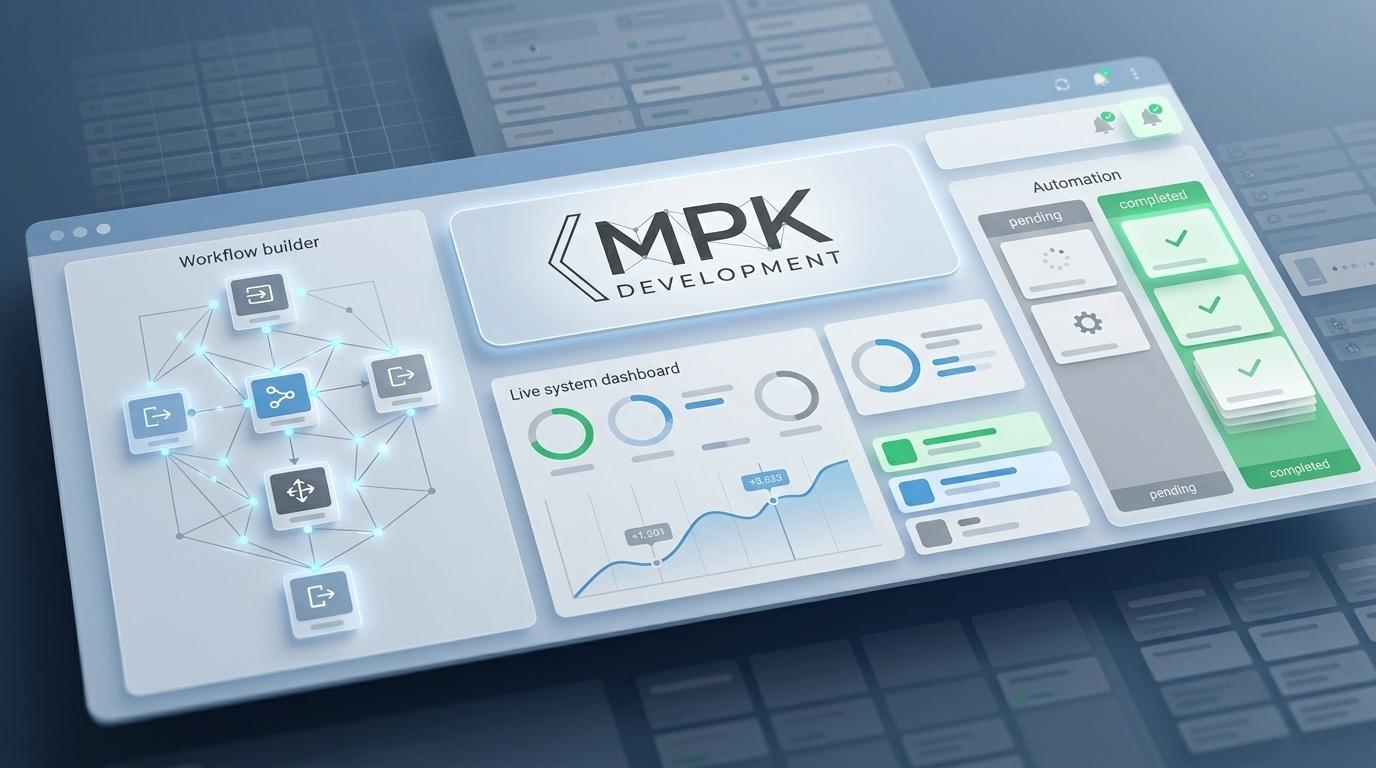
Your business runs on its own logic, exceptions, history, and priorities. We learn that first, design around it, and then decide what kind of business software, AI support, integration, automation, or architecture will move the operation forward.
Solution Design & Strategy
We map the real problem first: workflows, people, information, risk, and the practical system your business actually needs.
Learn more
AI-Assisted Systems
Practical AI features, guidance, and implementation support that help your team use AI in the right places, in the right way.
Learn more
Systems Integration
We connect the tools you already use so information moves properly and your team stops capturing the same thing twice.
Learn more
Planning Before Building
We listen first, then plan workflows, users, information, reporting, integrations, and future growth before decisions get locked in.
Learn more
Ongoing Partnership
We stay involved as a practical technology partner, helping the system improve as your business changes.
Learn more
Better systems start with understanding the work behind them.
Before anything changes, we ask how your team works, where things get stuck, what already helps, and what information needs to move. That is how we avoid quick fixes that need replacing a few months later.
Practical thinking, applied to daily work.
Most projects start with a simple frustration: too much admin, too many places to check, or too little visibility. We turn that into one clear, useful system, and we are honest when a smaller change is the better answer.
A central place to manage customers, work, documents, and tasks
AI applied to repetitive admin, document handling, and information sorting with clear human oversight
Dashboards that show what is actually happening without waiting for manual reports
Connections between finance, sales, customer, and admin tools
Turning a first version or AI-assisted prototype into something your team can trust
Automation for repeat work your team should not have to do manually
The best systems make the work feel lighter, not more complicated.
Across finance, property, operations, customer workflows, and admin-heavy processes, we solve real business problems, not technology problems for their own sake. The goal is less friction, clearer visibility, and a team that knows what to do next.
Whether you need a new internal business system, better-connected tools, practical AI implementation, or a first version made more reliable, we focus on the improvements your team can actually feel.

Intelligence applied where it creates real advantage.
AI can help with admin, documents, priorities, reporting, and decision-making. It works best when it is added with clear purpose, good information, sensible checks, and people still in control of the calls that matter.
We help you understand where AI belongs in your workflow, what should stay human-led, and how to implement it properly so it strengthens the business instead of quietly creating new risk.
Used well, AI becomes a practical part of the business: useful, controlled, and grounded in good judgment.
AI Support for Real Work
Use AI where it helps, and set it up with care.
You may already be using AI tools, or wondering what is worth automating, but it is not always clear what will support the business properly over time.
We help identify the right use cases, design practical AI features, and put the checks, structure, and human oversight in place so your team can trust the result.
Clearer Priorities
Help your team see what needs attention first.
When everything feels urgent, important work can get buried.
A smarter system can highlight deadlines, overdue work, busy areas, and the tasks that need attention, so your team can focus sooner.
Useful Business Insights
Turn everyday information into better decisions.
Most businesses already have useful information, but it is spread across too many places.
We build systems that surface trends, risks, and opportunities from your own data, so you can make better calls without waiting for manual reports.
Systems That Keep Improving
Make the system more helpful the longer your team uses it.
Most software does the same thing forever, even when your business changes.
We can design systems that learn from patterns, improve suggestions, and become more useful as your team uses them.
The goal is AI applied with judgment, in a way that genuinely improves how the work gets done.
Good systems start with better questions.
MPK is built on careful listening, practical judgment, and the discipline to turn useful ideas into business systems that hold up in the real world.
A good idea needs more than possibility. It needs the right problem clearly understood, the right architecture, the right controls, and a clear read on how real people will use it every day.
We partner. We design. We help you evolve.
We Start With The Work
Before we recommend anything, we learn how the business actually runs: who does what, where delays happen, what already works, and where information quietly gets lost.
Good solutions start with an honest read of the operation, not a feature list.
We Choose The Right Level Of Technology
Not every problem needs a full custom system. Sometimes the right answer is an integration, a process change, an AI-assisted workflow, or a smaller tool that solves the right problem well.
Good partnership means choosing the practical path, not the most complicated one.
We Use AI With Judgment
We use AI ourselves, and we help clients use it well. It can speed up work and improve systems, but it still needs structure, review, context, and human responsibility.
The point is to make better decisions faster, with the right controls in place.
We Partner From The Start
You know your business. We bring structure, design thinking, and technology judgment so good ideas can become dependable business systems.
Good partnership means spotting the risk before it becomes a rebuild.
We Think Beyond The First Version
A promising first version and a dependable system are different things. We consider permissions, data flow, performance, maintenance, support, and how the system may need to change later.
Good foundations reduce rebuilds, delays, and avoidable technical debt.
We Stay Practical
We explain trade-offs clearly, keep the work focused, and design systems that make sense for the people using them every day.
Clear thinking, steady delivery, and systems that earn their place.
We respect the systems, tools, AI experiments, and ideas that got you this far. We are here to listen properly, think clearly, and help your systems keep earning their place as the business changes.
A technology architecture studio for businesses that want to evolve.
We partner with businesses to design practical systems around the way they actually operate.
MPK Development works with businesses that have outgrown spreadsheets, disconnected tools, and systems that need stronger structure. We help bring clarity to the work so teams can operate with better visibility and fewer avoidable delays.
A new system is not always the answer. Sometimes an existing tool, a better process, practical AI support, or a careful integration is enough. Our job is to understand the business first, then recommend the right level of technology.
The goal is simple: solve the real problem, and deliver only what adds genuine operational value.
What We Focus On
We focus on the parts of a business where clearer thinking and better systems make a measurable difference: how information moves, how tasks are tracked, how decisions are made, and how teams keep work under control.
The work usually falls into a few clear areas:
Structure daily operations
Reduce repetitive admin
Improve visibility across the business
Support growth without adding unnecessary complexity
The outcome should not be a temporary workaround. It should be a dependable foundation your team can rely on every day.
Our Approach
We understand the work before deciding what should change.
Before anything starts, we take the time to understand how your business operates, where the friction is, which tools already work, and what genuinely needs to improve.
From there, we shape the right solution. That may be a custom business system, an integration, AI support, workflow automation, or simply a clearer plan.
Strong solutions come from clear thinking, not from adding more features.
How We Make The Work Stronger
We focus on practical decisions that make the system easier to use, easier to maintain, and easier to trust.
Technology should reduce friction, not create another layer of work. That is why we pay close attention to workflows, data, permissions, reporting, and the way real people will use the system every day.
Our focus is simple:
Clear workflows your team can follow
Fewer unnecessary steps
Decisions supported by the system, not fought against it
Every decision should make the system more useful, more reliable, or easier for the business to operate.
Built for the Long Term
We design with the next stage in mind.
A useful system should not fall apart the moment the business becomes busier, adds users, or changes how work gets done. We make decisions with maintainability, scale, and future improvement in mind.
That is the difference between software that only solves today's problem and systems that can keep supporting the business as it changes.
We partner.
We design what helps you evolve.
Tell us what should work better
Not sure exactly what the solution should be? That is fine. That is usually where the partnership starts. Tell us what is taking too much time, what keeps getting missed, or what you wish your systems did better.
Get in Touch
Send us a short note about the problem. We will help you think through what kind of system, integration, automation, AI support, or simpler operational change would make sense.